Return of the Ancient Mariner–er, Murrelet
Last year I reported the sad case of an Ancient Murrelet found dead on the icy shores of Okanagan Lake at Penticton, BC. Murrelets are birds of the open ocean, but this species shows a tendency (in some individuals at any rate) of occasionally straying inland to be seen on lakes across the continent. Despite birding in the Okanagan Valley for much of my life I’d never seen one away from the coast. But all that changed today.
At about 10:30 a.m. I got a phone call from Laure Neish, who breathlessly reported that she had found an Ancient Murrelet at the Penticton Yacht Club. I quickly said “I’m on my way”, hung up the phone, jumped on my bicycle (this is only 6 km from my house, so would be an easy species to add to my non-motorized transport list!) and was off down the hill in the steady drizzle. After a few anxious moments involving spray in the face, wet brakes and sharp corners, I arrived at the Yacht Club. Laure was there, and helpfully pointed out the bird near the far shore. It gradually came closer, then flew a few hundred metres to the west. I made some more phone calls, including one to Chris Charlesworth in Kelowna. He fortuitously was already out birding (why am I not surprised?) with Mike Force, so they turned south to cover the 1-hour drive to Penticton in prompt fashion.
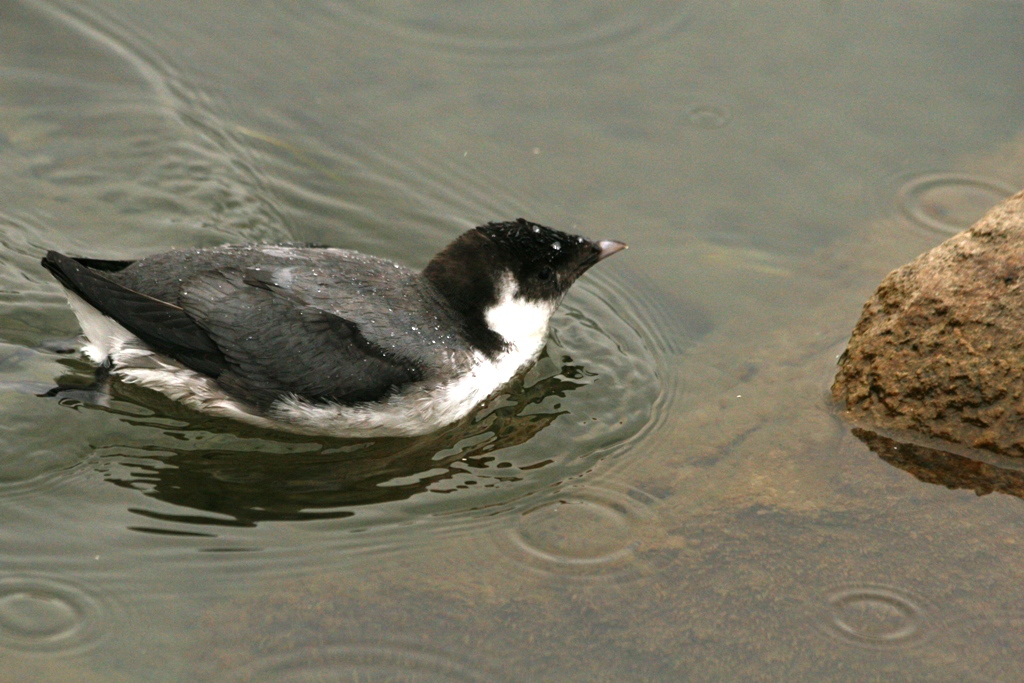
Ancient Murrelet, Okanagan Lake, Penticton, BC, 3 October 2011. photo by Dick Cannings
Meanwhile, Laure and I had lost the bird, but it eventually came around a corner of the rock breakwater, its feet churning like a sternwheel steamboat. It foraged within a foot or two of the shoreline, along the beach where its compatriot had met its end last year, and eventually came right along beside us. At one point, it bumped headlong into a rock while looking sideways at me. It kept moving west, and we lost it again for a few minutes, but eventually found it by the walking pier just before Chris and Mike arrived.
I’m not sure how many of these lost murrelets eventually find their way back to the saltchuck, but hopefully this one will survive to see Haida Gwaii–the main breeding site of this species–next summer.
Autumn in Ontario: working with Bird Studies Canada and the Nature Conservancy of Canada
I’m on my way home today from meetings with two of my favourite organizations: Bird Studies Canada and the Nature Conservancy of Canada. I work half-time for BSC, coordinating the Christmas Bird Count and eBird nationally, and the BC and Yukon Nocturnal Owl Survey. I also help with the BC Breeding Bird Atlas, and it was fun to see preliminary species-density maps produced by Andrew Couturier pulled out at the meetings. I was happily surprised to see the packed room at the BSC staff meeting—the organization has grown steadily since it was formed by the Long Point Bird Observatory in 1995, and now has strong offices across the country doing all sorts of interesting and valuable work.
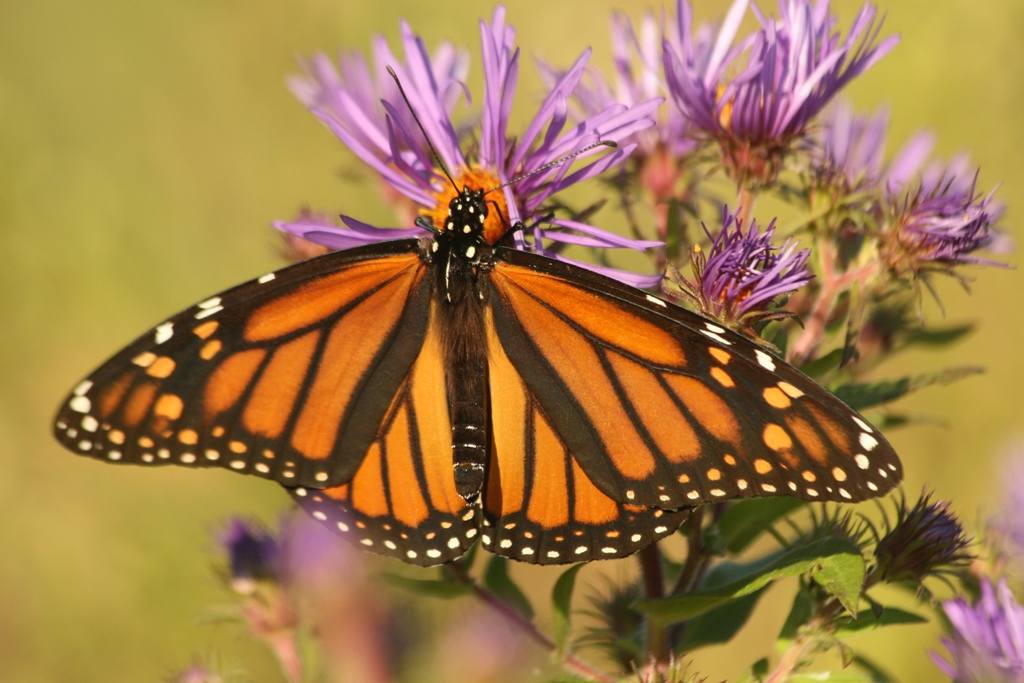
Monarch nectaring on asters at Bird Studies Canada headquarters
The staff and board meetings at BSC’s headquarters in Port Rowan, ON were preceded each day by informal birding trips to Old Cut, the banding station at the base of Long Point. Fall migration was still going strong, with mixed flocks of warblers (dominated by Blackpolls) and good numbers of Blue Jays moving overhead. A couple of times the nets were full enough that I got to help out the talented volunteers in extracting Philadelphia Vireos, Northern Parulas, Black-throated Green Warblers and other (exotic to me) eastern species. During lunch breaks, we walked through the tallgrass prairie meadow in front of the BSC headquarters building, which has matured over the last 5 years into a glorious mix of flowers and grass, dotted with groves of small trees. The asters were alive with nectaring butterflies, especially hundreds of monarchs that were beginning their epic journey to the highlands of Mexico. Buckeyes were common as well, and a few fiery skippers darted down the grass trails. I stayed with Andrew Couturier and his family in Simcoe; on Sunday afternoon we enjoyed a walk through Spooky Hollow, a glorious patch of Carolinian forest near the shores of Lake Erie.
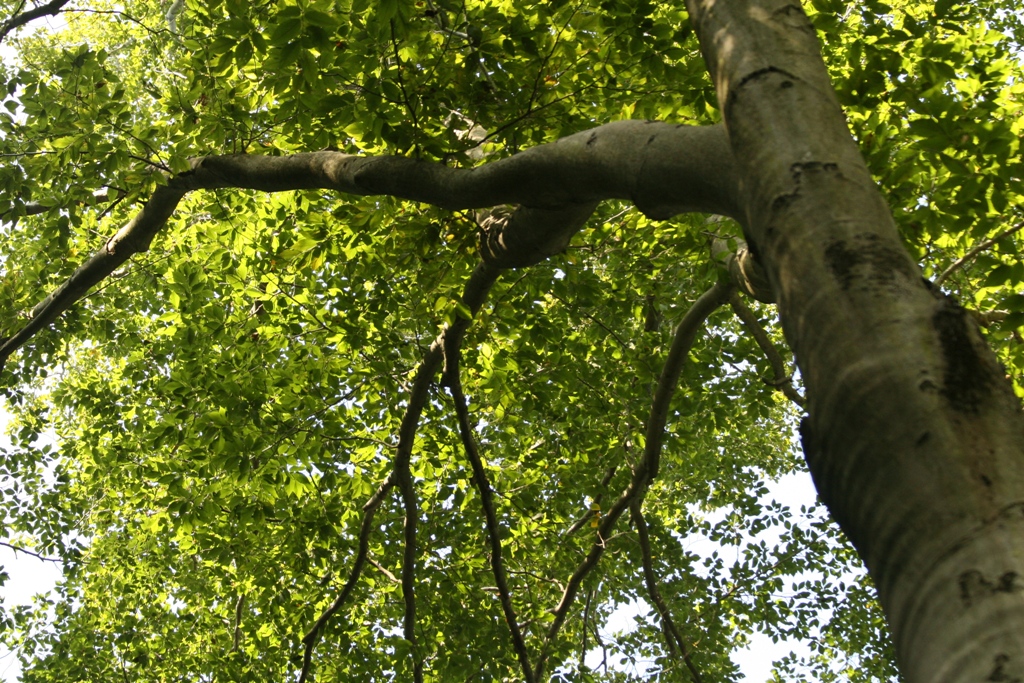
Large American beech in Spooky Hollow
Last Wednesday I travelled from Port Rowan to Kingston for the national board meeting of the Nature Conservancy of Canada. This is another dynamic organization that is very fulfilling to work with. I sit on the board with a cast of dedicated people from across the country, and am constantly amazed at the quality of projects our staff pull off every few months. The focus of these meetings was the work NCC is doing on the Frontenac Arch, a band of beautiful forest north of Kingston. The flora of these forests, growing on a southern extension of the granitic Canadian Shield, are a diverse mix of the Algonquin Highlands to the north and the Adirondack Mountains to the south.
We toured the region on Saturday, first visiting the Elbow Lake property, an 1100-acre piece of forest and lake recently purchased and now co-managed with Queen’s University. We then drove to Hawkridge Farm, where Michael and Elaine Davies have donated a 265-acre piece of gorgeous mixed forest, with some of the most northerly pitch pines in the world. Despite the blustery fall weather, we enjoyed the early autumn colours, a few migrants birds (including good numbers of Turkey Vultures tossed on the wind) and the heart-warming stories of important habitats conserved forever.
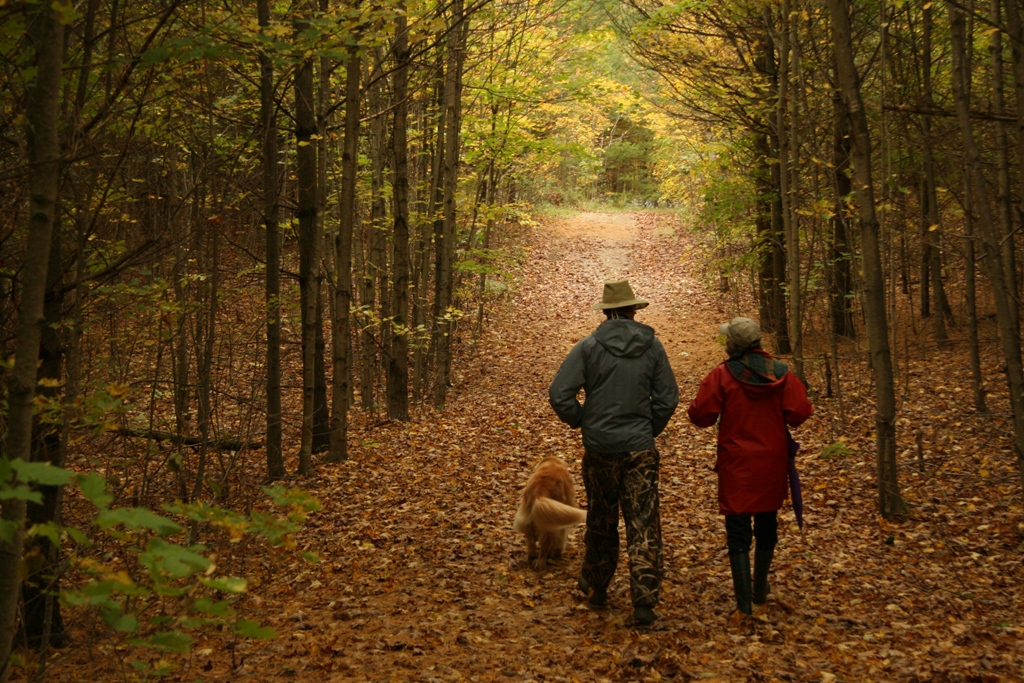
NCC biologist Gary Bell walks through the woods of Hawkridge Farm with Elaine Davies.
Wells Gray Day
Last weekend I drove north to Wells Gray Provincial Park to visit my friend Trevor Goward and help out with his campaign to protect a significant wildlife corridor in the Upper Clearwater Valley. Trevor had organized a “Wells Gray Day” packed with speakers and events that sounded well worth the long drive, if seeing that fabulous valley wasn’t enough. Trevor lives on an exquisite 10-acre property—“Edgewood Blue”—about 20 kilometres north of the town of Clearwater. I hadn’t been there for about 18 years, but remembered the driveway winding through a stand of mature aspen on a low ridge, leading to a house overlooking a pond filled with cattails and dragonflies.

Trevor Goward makes last-minute preparations for Wells Gray Day at Edgewood Blue
I arrived about 7 p.m. on Friday and was immediately put to work putting the finishing touches on the property for Saturday’s big event. Botanist Lynn Baldwin and I helped Trevor move gravel and rake it into position along new trails, finish the fire circle and bring in firewood. By the time darkness fell in earnest everything looked more than presentable—Trevor had obviously done a tremendous amount of work over the past few months turning his property into a learning centre, with a small amphitheatre overlooking the pond, a covered open-air classroom by the fire-pit, and several trails through the diverse woodlands and marshes.
The Wells Gray Day event was organized to celebrate Trevor’s donation of his property to the Land Conservancy of BC, along with a similar donation by his neighbours, Edwina and John Kurta. Thompson Rivers University is involved as well, since they have a field station across the road and will be using the properties for their outdoor classes and research. Bill Turner of TLC, Chief Nathan Matthew of the Secwepemc (Shuswap) Nation, and Terry Lake, BC’s Minister of the Environment, all welcomed us to the morning’s talks. Cathy Hickson, a volcanologist who has studied the incredible geology of Wells Gray for decades, gave us the highlights of the fascinating story of the region’s deep past, a story of fire and ice. Just before lunch we moved across to the TRU field station, where Tom Dickinson, Dean of Science at TRU, showed off the plans for the new facility. It was idyllic in the unseasonably warm September sun, with Compton’s Tortoiseshells dancing overhead and sunning themselves on the walls of the old one-room schoolhouse that is the main edifice on the site now. Ralph Ritcey, one of the éminences grises of BC wildlife biology, told stories of early moose studies in the valley.

Ralph Ritcey telling stories of moose and men
After lunch, CBC’s Mark Forsythe and I talked about the importance of park interpretation, including some reminiscences on my part about the golden days of BC park naturalists in the 1970s. The program was privatized in the 1980s and more or less died away from lack of funding in the last few years. We need to get this program going again—write Terry Lake and tell him so! As I prepared to tell a few stories about my park experiences I was surprised to see two of my old park superintendents in the audience—Herb Green and Pat Rogers. We broke into groups for the rest of the afternoon and walked the trails of Edgewood Blue, learning from each other about mosses, dragonflies and of course lichens. There were hardly any birds active in the hot, still afternoon sun—we saw a Song Sparrow and a Common Yellowthroat, but missed a Bald Eagle that flew over while we were admiring the small beauty of sundews!

The fate of park interpretation in British Columbia? The old outhouse at Edgewood Blue.
The day was capped off with a dinner in the historic log community hall down the road, followed by a wonderful talk on the Sepwepemc sense of place given by Ron and Marianne Ignace. A few of us gathered around a bonfire under the full moon, talking til past midnight about Wells Gray, the world and more. Well done, Trevor! And remember, Trevor will name a new lichen species after you if you win the “Name that Lichen” auction that is open until October 2nd–all proceeds go towards his Wells Gray conservation project.
The following morning I got up early and drove up the valley into Wells Gray Park itself, stopping first at Helmcken Falls, truly one of the most spectacular waterfalls on the continent. I then walked into Bailey’s Chute, since Mark had told me about seeing big chinook salmon leaping there the day before. It was mesmerizing to watch the roaring waters against the sunlit forest; I was pulled from my reverie at one point by the chatter of a dipper as it flew towards me and disappeared into the rock bluffs below my feet. It had probably had its fill of aquatic insects, and maybe a few salmon eggs, and was going for a bit of a nap. Maybe it was because of the early hour, but I had to wait patiently for about 30 minutes before a big fish–probably 30 pounds or so–rocketed out of the pool at the base of the falls and battled desperately against the crashing foam before being thrown back. These fish had come up the Fraser River, turned right at the Thompson, left at the North Thompson and left again at the Clearwater River–an amazing journey. And the ones trying to climb Bailey’s Chute were the real pioneers, the ones trying to blaze a new path above the spawning grounds below. We can learn something about persistence from these magnificent fish, a lesson that may prove useful in struggles to preserve this and other magical spots on earth.
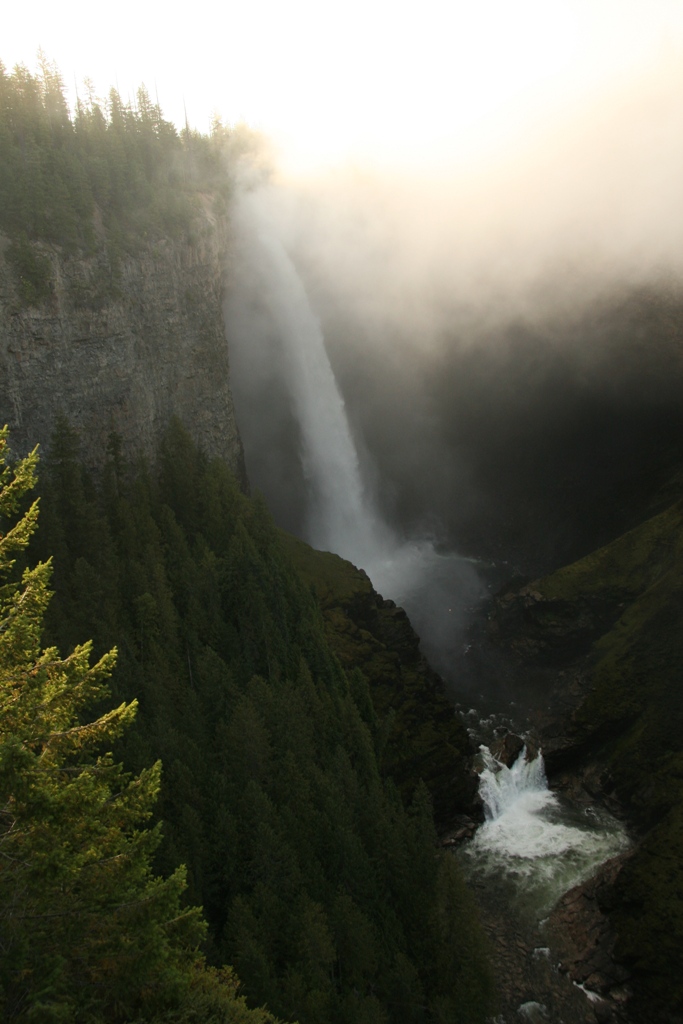
Misty dawn at Helmcken Falls
A late summer getaway at Cathedral Lakes
Marg and I just spent a glorious three days in one of my favourite places on earth—Cathedral Lakes. Nestled in the Okanagan Range of the North Cascade Mountains, these lakes are the jewels in a spectacular landscape. We were invited up there by a group of local school teachers who had come up with the ideal professional development idea—get inspired by soaking up the natural grandeur of the mountains, learning about geology, ecology and conservation.
We stayed at the Cathedral Lakes Lodge, located near treeline on the shores of Quiniscoe Lake. It’s hard to beat the idea of hiking in the alpine all day and coming home to a hot shower and great food! I’ve camped at Cathedral many times, but must admit the Lodge is always tempting. You can hike up to the lakes, but it’s a long, steep, dry 15-kilometre walk, so I’ve always taken the Lodge taxi service up. The drive is an adventure in itself, perched in the back of a Unimog as you climb up some pretty hairy mountainsides. You start in the hot pine-fir forests of the Ashnola Valley, and an hour later you’re at the lodge, with cool mountain breezes coming off the lake and late summer snowfields.
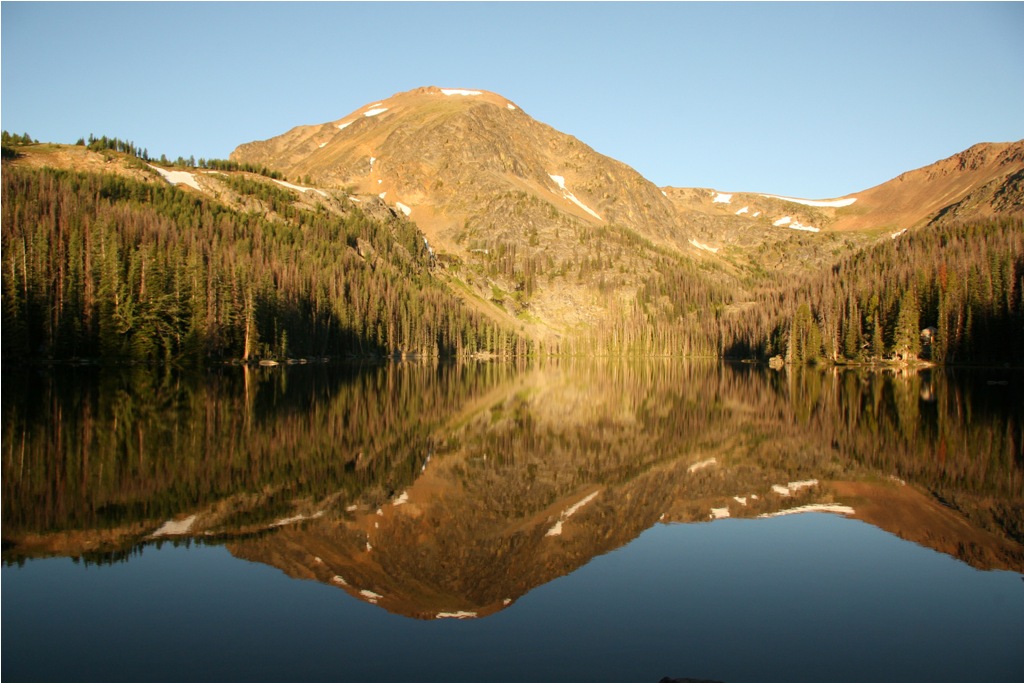
Calm morning: Quniscoe Lake and Quiniscoe Mountain
Cathedral Lakes is one of the finest places in British Columbia for mountain birding as well. Clark’s Nutcrackers are common around the Lodge, and Spruce Grouse are easily found in the subalpine forests nearby. Many trails climb up the cirque walls past rock bluffs and snowfields, where Gray-crowned Rosy-Finches are often seen. We took our first walk along the trail to Ladyslipper Lake. It begins in spruce forest that has been heavily impacted by a spruce beetle outbreak for the past five years or so. American Three-toed Woodpecker numbers soared after the beetles arrived, but now most of the large trees are long dead and we only heard one woodpecker calling. Younger trees are still common though, so the forest is very functional, and was full of mixed species flocks. A group of chickadees—both Mountain and Boreal—moved through the trees while juncos flew up from the grouseberry.
What was very noticeable were the flowers—the subalpine meadows were spectacular with lupines, daisies, arnica and paintbrush. Normally this bloom wave occurs in late July, but this year it was obviously 5 weeks late because of late, deep snowfalls and a cool start to summer. The snowpatch at the top of the trail—often melted by early August—was still large, it’s melting edge swarming with yellow springtails. As we reached the ridgetop, a Prairie Falcon rocketed by, probably on the lookout for Columbian groundsquirrels. A pair likely breeds on the cliffs of Crater Mountain, a few miles north, but this is still a very rare bird in British Columbia.
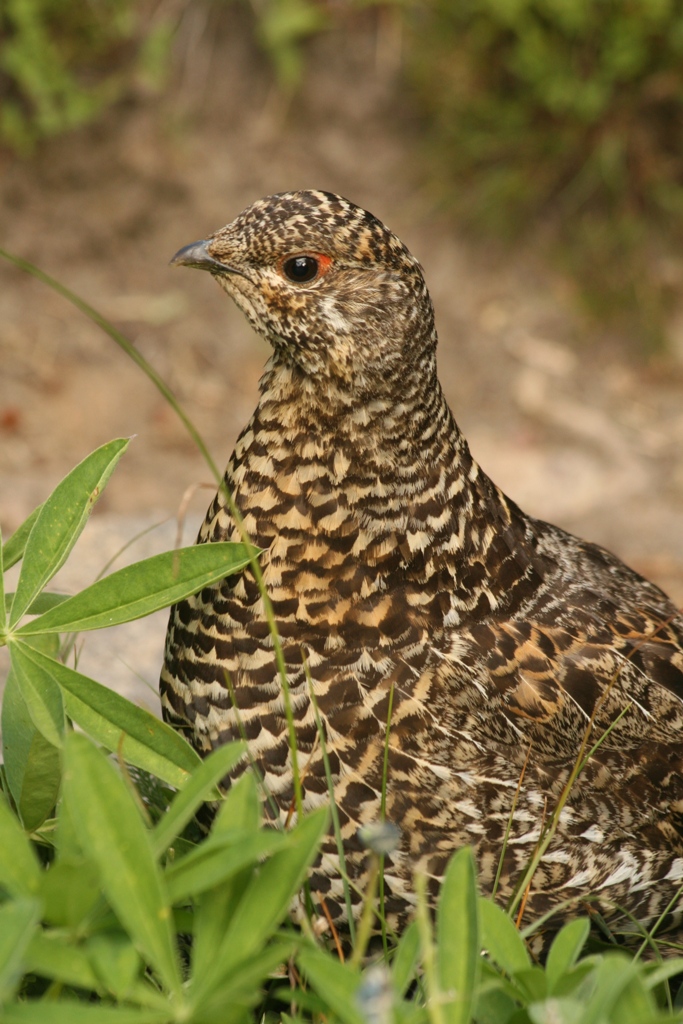
Female Spruce (Franklin's) Grouse
The next morning we took the trail to Glacier Lake, climbing the ridge where the movie “Clan of the Cave Bear”was filmed. I remember sending a couple of Californian birders up to the Cathedrals that summer to look for Spruce Grouse—I don’t know if they saw any, but they were certainly surprised to encounter a Neanderthal on the trail. Unaware of the movie shoot, they were dumbfounded by the sight, and even more surprised when the caveman calmly asked them how far the lodge was. We did see a Spruce Grouse on the trail—a female with a single small young. These grouse are often called “Franklin’s Grouse”, since they differ markedly from the eastern Spruce Grouse by lacking the reddish-brown tip to the black tail. The males also have a different display, one in which they flutter down from a tree branch and loudly clap their wings together over their back. The resulting double-clap is quite startling when heard on an early morning hike in the mountains.
The open slopes below the lake are carpeted in juniper bushes, full of grey-blue berries. Not surprisingly there was a Townsend’s Solitaire at the meadow edge, guarding its juniper patch. Another (or was it the same?) Prairie Falcon flew overhead, heading for Ladyslipper Lake, its crop full. We climbed beyond Glacier Lake to the cirque wall beyond. A couple of American Pipits fed in the steeply falling brook that came out of the snowfields above, but we didn’t see any Rosy Finches around the snowfields. They specialize in eating insects that become marooned on the cold snow while flying over mountain ridges on warm summer days. A couple of pikas gave their nasal enk! calls, scampering away with mouthfuls of hay.

Ladyslipper Lake from the Rim Trail
Once on the ridge we enjoyed the view of the North Cascades, from Glacier Peak in the south to the alpine ridges of Manning Park to the west. A big flock of Horned Larks twittered by, then dropped onto the tundra to forage in the grass. We walked south to the remarkable rock formations of Stone City, a collection of rounded quartz monzonite boulders the size of small houses. This ridgetop was not scoured by the continental glaciers that flowed south out of the Columbia and Rocky Mountains during the Pleistocene. The northeast side of the ridge was scooped out by a series of alpine glaciers, however, creating the cirque valleys that now hold Quiniscoe, Glacier, Pyramid and Ladyslipper Lakes.
Some of the group continued on from Stone City to explore Smokey the Bear and the Giant Cleft, rock formations in the huge wall that forms the south end of the ridge as it turns east to Goat Lake and Boxcar Mountain. Marg and I led separate groups back down into the valley. I took the steep scrambly route down to Ladyslipper Lake that goes through a magical meadow dotted with huge boulders. In the lee of each boulder huddled a stunted alpine larch. I’d expected to encounter a herd of mountain goats here, but they had obviously slipped behind some rock formation and we never did see them.

Giant Cleft: note hiker in gap for scale
Dawn on the following day was beautifully calm, Quiniscoe Lake a mirror for the orange tints of Quiniscoe Mountain, a glittering layer of late summer frost on the rustic dock in front of the lodge. We took a short walk to tiny Scout Lake that morning, finding a snowshoe hare feeding on grouseberry along the way. Some of the group took the long way back over Red Mountain, but after yesterday’s long hike, most of us were content to amble through the valley meadows and forests. The gang was quieter on the way down, tired but recharged with stories of adventure they can tell to their classes this fall.
Paddling the wild Okanagan
A couple of days ago Marg and I put the kayak in the lake for the first time this year. It was a perfect morning—sunny and calm but not too hot. We put in on the southeast corner of Okanagan lake and paddled north along the steep shoreline. This is one of the few wild shorelines left on Okanagan Lake, although the wild part only extends up the steep slopes and cliffs to the orchards and vineyards on the benches above. On a lake with 2700 private docks and 1800 retaining walls built along its shoreline, it was inspiring to explore a section that was essentially the way it was centuries ago. After a short stretch of paddling away from the busy beaches of Penticton, we were gliding past groves of birches and cottonwoods above pocket-sized natural beaches. The only obvious feature of this shoreline that wouldn’t have been here hundreds of years before was the presence of Russian olive trees. These trees were introduced from Eurasia, and have become common on the silty soils above the lake. But, unlike a lot of invasive plant species, Russian olives have a positive side–they produce many small whitish berries that are a favourite winter food of Western Bluebirds.

Silt bluffs along Okanagan Lake north of Penticton
Birds were conspicuous all along the shore. Family groups of Mallards and Canada Geese, the young by now almost adult-sized, foraged in the shallow water. Offshore, a pair of Common Loons drifted by, disappearing underwater at intervals to look for a fish breakfast. Might these birds nest along wild stretches of this shore? I’ve never heard of a loon nest being found on Okanagan Lake, but there are always loons on the lake through the summer.
At one point a huge Bald Eagle sailed in at cliff-top level and landed on a prominent point to survey the waters below. Eagles feed primarily on birds around here, so maybe the ducks were its target—they are rather vulnerable in midsummer during their flightless moult period. On land, fledgling Bullock’s Orioles chattered from the trees and the flame-orange adult males flashed between shrubs searching for caterpillars to feed them. A flock of Bank Swallows wheeled noisily around their colony built into the silt bluffs.

Okanagan Lake looking north to Summerland
These silt bluffs were formed at the close of the Pleistocene. The Okanagan Valley was filled with a huge glacier flowing south from the Monashee Mountains. About 12,000 years ago the climate warmed and the glacier came to a stop and began to melt in place. Lakes formed along either side of the glacier, filled with silty meltwaters flowing in from the mountains to the east and west. The silt settled to the bottom of the lakes to form deep sediments. When the glacier disappeared entirely, the silt deposits were left behind as benches on either side of the lake that filled the valley. For centuries the benches were covered in dry grasslands, forming a rich dark brown soil that now supports the vineyards and orchards around the south end of the lake. And the steep walls of the silt bluffs have kept this shoreline wild.
Heli-birding
Breeding Bird Atlas projects have many benefits, but one that I consistently enjoy is that they get you into places you normally wouldn’t go. Last week I found myself driving the Crowsnest Highway east across southern British Columbia, heading for the Rocky Mountain Trench. My destination was Bobbie Burns Lodge, a spot I hadn’t even heard of a month ago, let alone been to. Bobbie Burns is owned by Canadian Mountain Holidays (CMH), and some discussions about atlassing with their biologist Dave Butler had resulted in an invitation to come and speak to their guide training sessions about alpine ecology and birds. CMH is primarily a heli-skiing company, operating several lodges in southeastern British Columbia, but they also operate heli-hiking adventures in the summer out of two of their lodges in the Purcell Mountains, just west of the Rockies. One of the main challenges we face in the British Columbia Breeding Bird Atlas is getting into alpine areas to survey birds, especially in cool, wet springs such as this one, when the deep snowpack makes access by road or trail difficult. Heli-birding in the Purcells sounded like too good an opportunity to turn down.
It’s a long way from my home to the Rockies, so I stopped off in Creston overnight. I’d arranged with Patricia Huet, the regional coordinator for the atlas there, to do some point counts in a square east of Creston the next morning. My plan was to drive the Carroll Creek Forest Service Road, one that I’d covered for general atlassing a couple of years ago. I got to the first stop and pulled off as far as I could on the narrow road and began counting—Olive-sided Flycatcher, Steller’s Jay, Lazuli Bunting, Rufous Hummingbird, couple of Gray Jays, 1-2-3-4-5 Swainson’s Thrushes. Then a huge logging truck rounded the corner and roared by. I quickly realized that this was not a healthy situation—I was on a narrow road without the usual radio needed to notify the big trucks of my position. I decided to try another square for safety sake, and quickly drove back to the highway, dodging another truck on the way. I spent the rest of the morning birding the back roads around Yahk. After counting a lot of Hammond’s Flycatchers, MacGillivray’s Warblers, Cassin’s Vireos and even more Swainson’s Thrushes I was back on the highway, turning north into the Rocky Mountain Trench at Cranbrook.
The Rocky Mountain Trench is a valley that seems unnaturally straight. The section in southern British Columbia dropped down about 1000 metres around 50 million years ago as tectonic pressures on the Pacific coast eased, creating a massive valley with fabulous scenery and an abundance of flat, marshy habitats that are rare elsewhere in British Columbia. I drove north past the grasslands of Skookumchuck and the wetlands of Bummer’s Flats to Columbia Lake, headwaters of the mighty Columbia River. Farther north I stopped at a few ponds to check out Bald Eagle and Osprey nests—easy pickings for atlassers. I finally got to Parson, a little logging town just south of Golden. There I met the guides going in to Bobbie Burns for the training sessions, and we car-pooled for the 60-kilometre drive west along logging roads into the heart of the Purcell range. At one point a big black bear romped along the road, but the mammalian highlight came just as we reached the lodge, where a dark wolf loped ahead of us before turning into the forest.
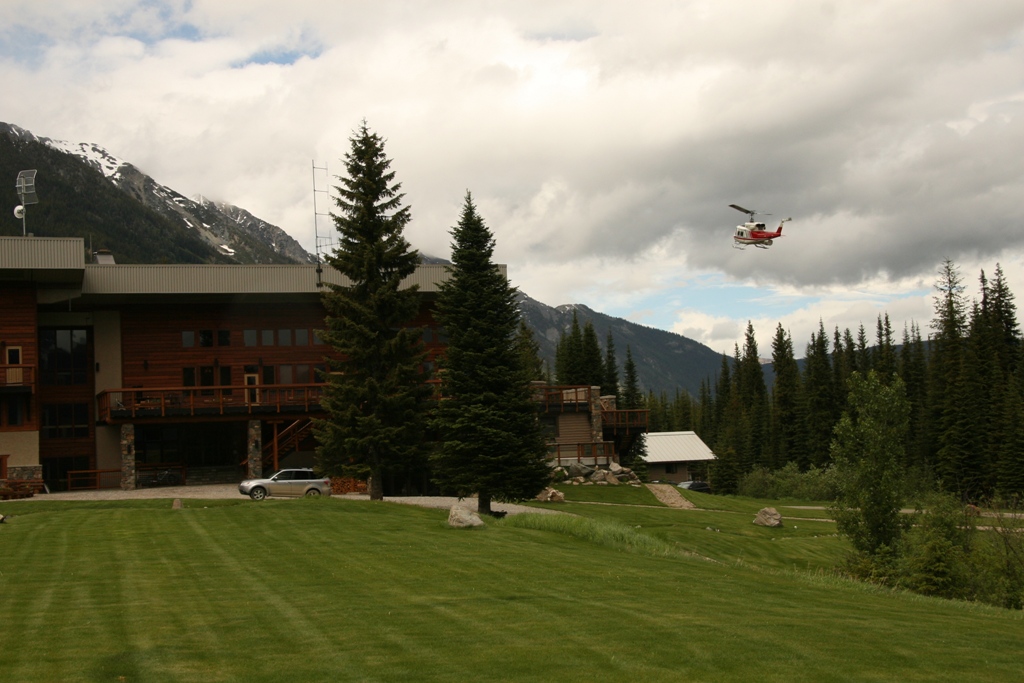
Bobbie Burns Lodge
Bobbie Burns Lodge is not a rustic cabin in the woods—it’s a 5-star facility with great rooms, fine food and wonderful staff. There were no phones in the rooms, but high speed wi-fi was magically available. Lasers in the jungle. After dinner and some introductory talks, I went to sleep with the steady drumming of rain on the window—not a good sign for tommorow’s helicopter adventure. It was still raining at 5 a.m., so I rolled over and slept in until 6:30. We weren’t going to fly until 10, but I wanted to get some point counts done in the valley. Between drizzly showers I managed to put in a dozen counts, tallying the usual subalpine species—Pine Grosbeak, Olive-sided Flycatcher, Hermit Thrush, Varied Thrush, Townsend’s Warbler, MacGillivray’s Warbler, Wilson’s Warbler, and more. The weather didn’t look much better as we gathered for the helicopter safety talk—watch out for the rear rotor, hold on to your hats (they clog the engine), crouch beside the machine.
We rose out of the Vowell Creek valley and were soon cruising over snowy meadows and ridges. The helicopter circled and landed on a high pass between two minor peaks. Most of the ridges and lesser peaks in this range don’t have official names, but the guides called this Zebra Ridge. It was certainly white with black stripes—completely snow-covered except for windswept slopes and the ridgeline itself. We stepped out of the helicopter and crouched on the slaty scree next to it as it lifted off and disappeared into the distance. The wind was howling on the ridge, and I quickly realized this would be a day with few birds seen.

A windy day on Zebra Ridge
The guides decided to traverse across the scree slope to get off the ridge and its strong winds. At 2550 metres (8360 feet) elevation, we were well above the local treeline, and the only signs of life were tiny alpine plants such as Draba and Sibbaldia tucked into the dark rocks. At one point I heard a Horned Lark sing, but its tinkling song was blown away on the wind. I picked up a lot of mountain-guide lore on the hike, such as how to kick steps in scree (push down from above) and how to walk safely on snow (make your own steps with a small stride). I’ve been doing these things for years, but never really thought about how to do them well.
After a long traverse we turned downhill and descended swiftly to the snow-filled cirque. We stopped for lunch at the edge of the snow, beside a huge mat of fir krummholz. As I munched on my sandwich I heard some high-pitched calls, like those given by Chipping Sparrows. I looked upslope and saw a small sparrow perched on one of the shrubby firs, and before I could raise my binoculars it burst into song and I heard the amazing, canary-like trills of a Brewer’s Sparrow. I know this species well from the sagebrush grasslands where I live in the Okanagan Valley, a radically different habitat in many ways from this frigid mountainside. In fact, the subspecies living in these alpine habitats from the Canadian Rockies north to Alaska is often considered a separate species, the Timberline Sparrow, since it has a different song (“…like a Brewer’s Sparrow on helium”, says Bruce MacGillivray, an Alberta ornithologist), slightly different plumage, and obviously occupies a different part of the world. I’d only seen this subspecies once before—a bird singing in Mount Robson Park, just over the divide from Jasper.
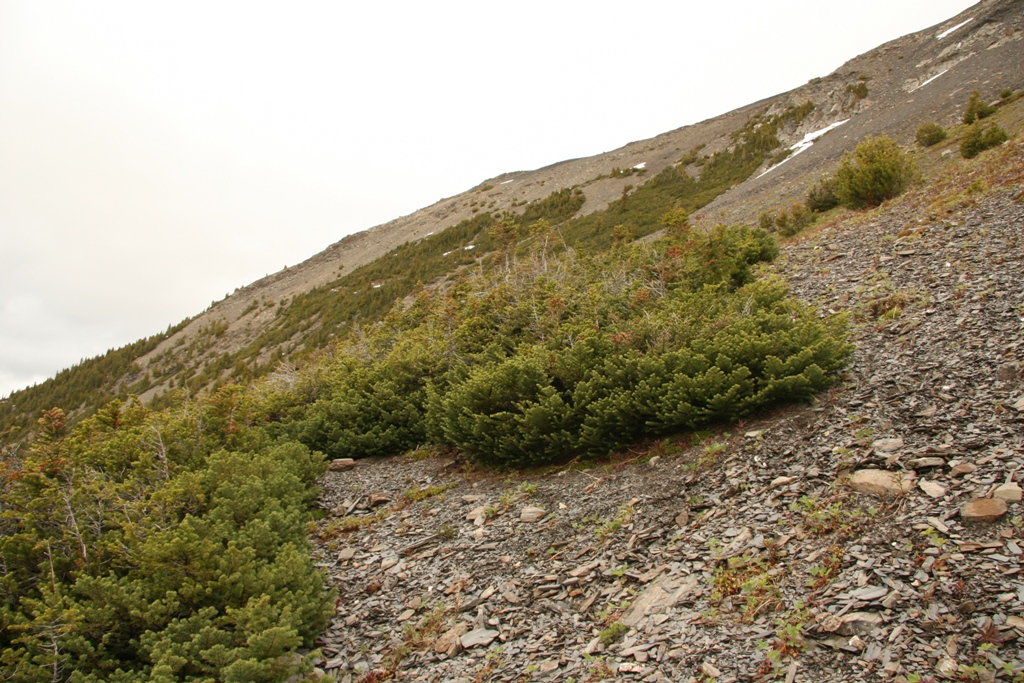
Timberline Sparrow habitat

Grylloblattid
Happy with that sighting, I followed the others as we hiked up the cirque, now on deep snow most of the time. One of the guides pointed out a grylloblattid dead on the snow. Grylloblattids are unusual insects that live in rocky scree, usually near snowfields, and represent the only insect Order first discovered in Canada. I’d heard about these from my entomologist brothers, but had never seen one.
Most of the guides decided to climb the cirque wall to a distant ridge, but I decided to stay in the bowl and search for the small ridges of rock and shrubs that were snow-free. By now it was raining pretty seriously, so bird life continued to be pretty quiet. A couple of times I heard Gray-Crowned Rosy Finches calling overhead, and after the rain let up someone pointed out an American Pipit by a small tarn. We followed ptarmigan tracks across the snow but couldn’t find any of those little grouse. A pika watched us from a rock outpost and then the rain came back in earnest. I must admit I was happy to hear the dull roar of the helicopter as it returned around 3 p.m.—we picked out a safe landing site and crouched as it approached. Even though I was kneeling in a good football stance, the rotor wash bowled me over and I rolled away on the snow—I’m sure the pilot had a good chuckle over that.
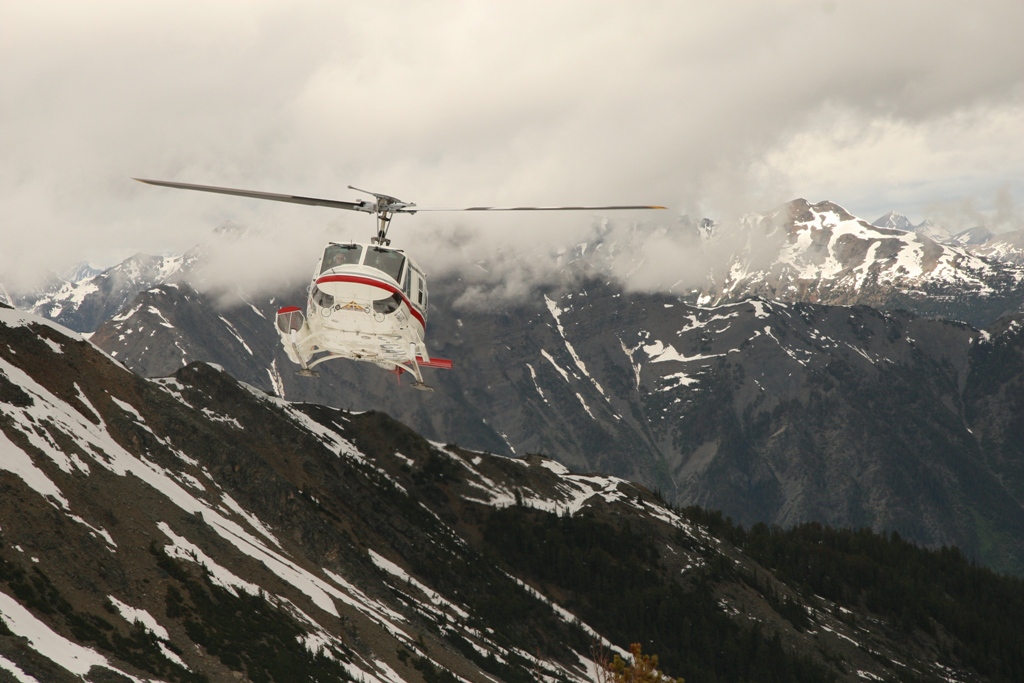
helicopter pick-up in the Purcells
Within minutes we were back at the lodge, with showers, dry clothes, and another great supper awaiting us. It rained all that night, though by 6:30 a.m. it had cleared and I managed to do a few more point counts. The forecast was not good though—severe thunderstorms by noon. Thinking of the deep snow pack and, let’s face it, worried about the prospect of getting zapped off a ridge by lightning, I decided to forego the alpine and said my farewells and thank-yous to the CMH gang. It had been a great trip despite the weather, and even though I’ve been hiking in the mountains all my life I learned a few things from the guides. They seemed keen on bird atlassing as well, so I’m hoping to get some interesting emails over the next couple of summers reporting on ptarmigan broods and lark nests tucked into the alpine grass.
Flicker dramatics
I have a couple of nice birch snags in my garden, and the one that’s close to the house (only 10 metres from the dining room window) has a nice cavity excavated last year by a pair of flickers. As soon as the cavity was finished one of the local starling pairs decided that it would make a nice nest site for themselves, and began a protracted battle with the flickers. Eventually the flickers managed to lay a clutch of eggs, but the constant harassment continued as they tried to incubate the eggs, and eventually the flickers gave up and abandoned the nest.
This spring the struggle was on again. The flickers cleaned out the cavity and things looked good, but the starlings fought back and began to make a nest in the cavity with grass and feathers. The flickers fought back and one day I saw them pulling the starling nest out of the hole; in the pile of debris on the lawn lay a single flicker egg, presumably laid before the starlings took over. To our relief, the flickers prevailed and the starlings stopped all attacks on the nest. We enjoyed watching the pair switch incubation and brooding duties throughout the day and last week I noticed that the young were big enough to meet their parents at the cavity entrance.
One point of interest is that the male flicker was an intergrade between the western Red-shafted Flicker and the eastern/northern Yellow-shafted Flicker, having the red mustache of the Red-shafted but also the red nape patch of the Yellow-shafted. Normally we have only pure Red-shafted nesting in southern British Columbia, while the Yellow-shafted form nests across the northern third of the province. In central BC there is a broad zone of intergradation where many birds have intermediate characters. We see these birds in the winter, but most go back to the Carib00-Chilcotin or Fraser Plateau to nest.
Last week we hosted a garden party with 30 people eating dinner within a few steps of the nest, and the birds continued to feed their young. Laure Neish came by to photograph the birds a couple of days ago, and you can see some of her photos on her website. She noticed that one of the male nestlings had the same red mustache and red nape combination as its father.

juvenile flicker feathers scattered below nest
I expected the young to fledge in a week or so, but yesterday it all came to a premature end. Seeing some of the honeysuckle vine torn down, I went to investigate. My heart sank as I saw flicker feathers scattered through the downed honeysuckle, and a glance at the nest cavity told the rest of the story. The hole had been ripped wide open. Only one animal common in my yard could or would do that, and the claw marks on the birch bark confirmed it. A black bear had climbed the trunk and opened the nest for breakfast. I know nature is red in tooth and claw, and I’m happy that bears do natural things in my yard instead of eating garbage (or my tomatoes), but it was tough to see two years of effort by that pair of flickers be wiped out so easily.

flicker nest cavity torn open by black bear
Postscript: Just now I saw one of the fledglings hopping around the garden–so it appears that some survived the attack.
The Bi-Coastal Challenge: East Coast edition
guest author: Blake Maybank
Earlier this year Dick Cannings and I had agreed to organise the Guest Teams for the 2011 Bird Studies Canada’s Baillie Birdathon, its annual fund-raiser. The original premise was a straight-forward Big Day competition between Canada’s two longitudinal coasts, east and west. But there was nothing straight-forward about this proposal, as British Columbia birders would always be able to tally a higher species total (location, location, location), and I could not determine how we could create any workable handicapping system.
Instead we proposed a Bi-Coastal Birdathon (soon known to Dick and I as the Bi-Polar Birdathon), wherein we would combine the results from the two birdathons and, eliminating duplicate species, attempt to reach a total of 250 species.
Dick and I sent preliminary planning lists back and forth, tentatively assigning provincial responsibilities regarding finding certain species. And we assembled teams of willing participants. Nova Scotians are nothing if not polite, and we agreed that British Columbia should go first. And so, on May 18 Dick and his eager and skilled team set a new British Columbia Big Day record, finding 202 species in one day. This was good news for them, and also for us in Nova Scotia, as it meant that the BC birders had “ticked” many of the “shared” species, leaving the Bluenose Birding team with the task of finding just 48 new species to bring the combined total to 250.
Our team consisted of three, myself, Dave Currie, and Mike King. Dave is an experienced local birder (he coordinates Christmas Bird Counts for the province), recently retired, and eager for any chance to go afield. Mike is a younger birder, with more energy and better ears than Dave and I put together, and is an enthusiastic photographer. Together we undertook preliminary planning, but we were hampered by one over-whelming factor – the Maritime provinces were experiencing one of the cloudiest, foggiest, wettest springs in many years, and bird migration, especially in Nova Scotia, was delayed. And species that were arriving were doing so in small numbers.
While May is the month in BC in which the biggest Big Day totals can be achieved, in Nova Scotia it is June, so we decided to wait as long as possible in the month to allow as many birds as possible to return. And we were waiting for a sunny day, or at least a day in which the wind was not blowing from the south, thereby cloaking the south-facing Atlantic coastlines in thick fog. Forecasters would periodically throw up the promise of a sunshine “in several days”, but such promises would invariably be found wanting, as the sun did not materialise. Indeed, in Halifax, there were just 14 hours of sunshine in the first 30 days of May.
We had to run our Birdathon in May (Baillie Rules), so we set Sunday, May 29 as our day, as traffic would be light, all team members were available, and the forecast called for sunny breaks. But as Sunday approached the forecast changed (surprise!), and instead the day was offering the constant flow of foggy southerly winds.
Fog would not necessarily impede our forest birding that much, as most of the productive areas were inland, but we needed a number of coastal species if we were to have any chance to reach 250, and most of those coastal species were in Shelburne and Yarmouth Counties, which are “fog central” when spring winds blow from the south.
As a back-up plan we made arrangements to head to Cape Breton, where Donelda, of Donelda’s Puffin Tours, agreed to take us out quickly to the Bird Islands off Englishtown, where fog is less of a problem, and where several key species nest; Great Cormorant, Black-legged Kittiwake, Atlantic Puffin, Black Guillemot, and Razorbill. And there would be Common Eiders, Northern Gannets, and Arctic Terns as well. But it would be a five hour drive from Halifax, against a three hour drive to the south shore.
As we were trying to decide our itinerary we kept gazing at the longer-range forecast for Tuesday, May 31, the last possible day we could run our Birdathon. Every forecaster we could locate was promising a one-day shift to a northerly air flow, accompanied by sunny skies, and relatively light winds. If this forecast held up then Tuesday would be our day. But there were two problems – Mike would not be available on Tuesday, and if the forecast was wrong we’d be back in the pea soup.
With regrets to Mike, Dave and I decided to pin our hopes on Tuesday, and we managed to find a replacement when Jim Edsall agreed to assist. Jim is a renowned award-winning bird carver, a long-time birder, and a butterfly and dragonfly expert as well. He’d recently moved back to his home province of Nova Scotia from neighbouring New Brunswick, and this was a great way to get him back into the game.
Our planning continued. We created our Target List of species, which we divided into three categories. The “Core” list consisted of 26 species sufficiently common along our route that special planning was not required – we’d hear or see these species in passing, while searching for the more fussy species. The “Planning” list comprised the less-common or rare species for which specific stops were planned, based on our knowledge of their breeding areas, or advance tips from other birders (I had sent out a request to the province’s birders for sites for many of these species). There were 28 species on the Planning list. Finally, the “Lucky” list was a grouping of 18 rare (but annual) species for which no specific sites were known. Serendipity was required.
This was a possible total of 72 species, and as we only needed 48, we were cautiously optimistic. But it all hinged on the weather.
As Tuesday approached the forecast remained steady, much to our surprise and delight. The game was afoot.
We rendezvoused at Jim’s Dartmouth residence at 0230. We did not require a midnight start, as the BC team had tallied all the owls and rails we might find in Nova Scotia, leaving us only three night-specialist species – American Woodcock, American Bittern, and Common Nighthawk. All three were possible along the same stretch of road, the Old Guysborough Road, running from behind Stanfield International Airport to the Musquodoboit Valley. Dave had done some scouting here a week earlier, and at our first stop, just off the airport perimeter, we heard the woodcock, despite the noise of idling planes. The second (quieter) stop produced both the bittern and the nighthawk, as well as a Northern Saw-whet Owl, which was not on our target list, but was welcomed regardless.
It was not yet 0400 and we had accomplished our night mission, so we continued to the Musquodoboit River valley and linked up with Route 357, which parallels the river to its mouth in the village of Musquodoboit Harbour. We drove to the village and parked at the trail head for the Musquodoboit Rail-Trail, and walked the first 200 metres to the bridge over the river. As dawn approached the bird song began, and while many species had already been tagged by the West Coasters (robins, Song Sparrows, etc, etc), we did hear many of our Target Birds; Alder Flycatcher, Blue Jay, Swainson’s Thrush, Magnolia Warbler, American Redstart, Swamp Sparrow, White-throated Sparrow, and Common Grackle.
But it was time to drive back up the valley, stopping at as many different habitat types as we could, coniferous forests, mixed-wood forests, bogs, streams, and meadows. By 0630 we were nearing the village of Meagher’s Grant, having added, from our Core List, Blue-headed Vireo, Red-eyed Vireo, Winter Wren, Cedar Waxwing, Northern Parula, Chestnut-sided Warbler, Black-throated Green Warbler, Blackburnian Warbler, and Black-and-white Warbler. As well we were fortunate to find three of the “Planning” List warblers, Palm, Bay-breasted, and Canada. As we drove slowly through Meagher’s Grant we kept a look out for hummingbird feeders, and this strategy paid off as we watched an aerial fight between two Ruby-throated Hummingbirds.
We reached Elderbank, the junction of 357 and the Old Guysborough Road, at 0700, ahead of schedule. We saw American Black Ducks on the Elderbank Marsh, and did a preliminary tally – we had 26 Target Species, over half way already. But a long day loomed ahead.
We drove back on the Old Guysborough Road towards the airport and turned into Dollar Lake Provincial Park, only to find the gates closed. May 31 and the park was still not open? Remarkable, though many parks in this financially-strapped province are open for only a ten-week season. While we gazed in frustration at the closed gate an Ovenbird (#27) sang nearby, hinting at the birds of the mature deciduous forest that lurked in the main part of the park, too distant to reach on foot. A back-up plan was needed, and we talked options as we drove to the airport. Then, a break, as a pair of Broad-winged Hawks showed themselves, our first species from our Lucky List (#28).
First though, we had a stake-out species to check. Jacques Perron had alerted us to an Eastern Phoebe nest in Elderbank, a diversion that would add only 10 or so minutes to our route. With accurate GPS coordinates we found the site easily, and before the car had stopped we saw an adult phoebe fly through an open door into a small storage shed. (#29).
We now headed south, taking the Bicentennial Highway around Halifax Harbour. Dave suggested that we might consider a short detour between two exits, to explore a stand of good deciduous forest beside Rocky Lake, in Powder Mill Park. As we were ahead of schedule we agreed to this, and 30 minutes (an d a brisk 2 km walk) later, we had added Black-throated Blue Warbler and Eastern Wood-Pewee (#30 and #31). We now had encountered all the expected forest species for this portion of our trip, save for Yellow-bellied Sapsucker and Olive-sided Flycatcher. It was hard to explain the silence from the former, as it is a common and noisy species, but the absence of the flycatcher was likely due the late spring.
We drove a short cut to Hwy 103, which leads to Nova Scotia’s south shore, and arrived at Tantallon at 0900, almost two hours ahead of schedule. Our success at Powder Mill Park meant we could skip the Lewis Lake area, but we felt we had time for a quick run into the forestry lands owned by Abitibi-Price/Bowater, to try for the sapsucker and the flycatcher. We did this, but this time our luck failed us, and we left the area 45 minutes later no further ahead.
To the south, then. We had a planned stop en route in Milton, outside of Liverpool, where Dorothy Poole had told us of three good candidates for our list, Northern Cardinal, Baltimore Oriole, and Great Crested Flycatcher, all three scarce provincial breeders, and on our Planning List. But first Dave had another idea. He knew of a house in Mahone Bay in whose back yard a pair of cardinals had taken up residence, so we slipped off the highway once again and made a pass through the town, one of the prettiest in the province. When we arrived at Ken’s house there was loud yard work in progress, so the cardinals were keeping a low profile. On spec we checked out an adjacent wooded street with an adjoining undeveloped lot, hoping the cardinals were lurking there. No such luck, but instead were rewarded with the calls of Great Crested Flycatcher (#32).
Next to Milton, where we were greeted by Dorothy with the news that the oriole and flycatcher had been calling up to 10 minutes earlier, but now all was silence. We did not now need the flycatcher of course, but we spent more than 30 minutes in a vain effort to locate the oriole. As consolation a cardinal called a few times (#33) so our stop was not in vain. And a Herring Gull (#34) flew along the Mersey River; the species was entirely expected, of course, but it was odd we hadn’t seen one yet during the day.
Southward again. Our initial plan had been to go to the Pubnicos, where all three species of tern (Common, Arctic, and Roseate) nest on The Brothers islands, and in the absence of fog we could see them all from the mainland. And Blackpoll Warblers nest on Pubnico Point, assuming they were back yet. Given the state of the tide, however, we decided to first go to Cape Sable Island (linked by a causeway to North America) to make a serious assault on our coastal species. As we crossed the causeway we could see many Great Black-backed Gulls (#35), but we didn’t stop, and drove straight to Daniel’s Head, one of the hot spots on the island, an area of salt marsh, mud flat, and sand dunes. We had been well primed regarding the disposition of the island’s birds by local birder Johnny Nickerson, and upon arrival at Daniel’s Head we quickly added Black-crowned Night-Heron (#36), Willet (#37), and Common Eider (#38). There was no sign, however, of the breeding pair of American Oystercatchers, one of the key species for the island – this is the only regular breeding site for the species in Canada.
We planned to return to Daniel’s Head for another try for the Oystercatcher, and there was the small matter of the Piping Plovers nesting on Daniel’s Head Beach. But first to The Hawk, the southern tip of the island, and not, oddly enough, named for any bird. We first checked “The Hole” an alder-covered migrant trap, where a pair of Brown Thrashers had been “tending” as we’d been informed by Johnny. But not while we were there. While trying to locate this locally rare breeding species I heard a song I confidently identified as a Blackpoll Warbler, but Jim tracked it down to prove it was an excited migrant Black-and-white Warbler. While I was commiserating Dave chanced upon a lovely migrant Tennessee Warbler (#39), a real bonus, and a budworm specialist species that is in very short supply, as the budworms are in a low cycle in the east.
Next it was over to the Lobster Pound, where we could look upon the mudflats between Cape Sable Island and Cape Sable, the latter a 5-km long sand and rock bar that borders the southeast shore of Cape Sable Island. Shorebirds appeared as the 8-9 metre tide receded, and while most of the revealed species had been found in BC (Dunlin, Red Knot, Black-bellied Plover), the Ruddy Turnstone and two Greater Yellowlegs were new (#40, #41). But we weren’t finished with The Hawk. We ventured the short distance to the end of The Hawk road, and were surprised and pleased to find a second pair of Brown Thrashers (#42), making up for the quiet birds at “The Hole”.
Access to Cape Sable is by private boat, and while we didn’t plan on visiting the Cape, we did wish to go to Green Island, which lies in the open ocean just beyond. Atlantic Puffins had been noted a year earlier prospecting on Green Island, and in 2011 they had returned and had commenced nesting. The boatman to get us there was Leslie Smith, retired from the Coast Guard, and someone who knew every rock and ledge and current and cove. As we headed over to his home in Clark’s Harbour we stopped first at Johnny’s in a vain attempt to see the Fox Sparrow which daily (and repeatedly) visits his feeder.
Leslie greeted us with his inexhaustible cheerfulness, and such good humour is a must, as most passengers are a bit nervous getting into his 15 foot boat with 8 hp motor. The boat is fine for the quick trips to the Cape, but although Leslie happily putters about everywhere in his small boat, less experienced mainlanders are understandably nervous when he ventures into the open ocean. The winds were modest, not even to the “Small Craft Warning” level, but the waves were angled to us and, as Johnny promised, we washed our faces. It was a quiet trio of birders as Leslie carefully navigated his small craft (especially small compared to the many large lobster boats that were retrieving their gear on this last day of the lobster season), but we made progress, and as we approached Green Island our spirits were raised by the appearance of new species: Arctic Tern (#43); Great Cormorant (#44); Roseate Tern (#45); Black Guillemot (#46); Northern Gannet (#47); a completely unexpected Razorbill (#48); and, of course, Atlantic Puffin (#49). It was especially gratifying to reach the 250 goal with the Razorbill and surpass it with such a sexy bird as Atlantic Puffin—we were in a splendid mood as we returned to Cape Sable Island.

Dave Currie, Leslie Smith and Blake Maybank at Clark's Harbour
Leslie landed us safely, as expected, and after our thanks we revisited Johnny’s feeder (still no Fox Sparrow), and then returned to Daniel’s Head. This time the pair of oystercatchers were showing (#50), so we then quickly walked the beach to find a Piping Plover foraging well outside its marked protected area (#51).
It was time to begin the drive home – and was that a hint of sunburn on our faces? Who would credit it? We decided to forego a long side trip for a Whip-poor-will in Yarmouth County, but did return to Dorothy’s house in Milton, and this time the Baltimore Oriole was singing up a storm (#52), perhaps in celebration of our reaching 250. As a final bonus during the drive back to Halifax a pair of Rose-breasted Grosbeaks flew in front of the vehicle – #53, and the last species for the day.
Our total species list was only 105 species, but this was to be expected. We’d skipped a lot of habitats and had not spent a full 24 hours in the venture. It wouldn’t have been unreasonable to find an additional 30 species if we’d pursued a “proper” Big Day, but we’d never have achieved a total such as they managed in BC. Regardless, we were content. We’d found 25 of 26 Core Species (where were the sapsuckers?), 23 of 28 Planning Species (three of which hadn’t returned yet), and five bonus species. The Bi-Polar Bi-Coastal Birdathon reaches 255! All courtesy of the one good day of weather in the entire month of May, and the enthusiasm and good spirits of Dave and Jim.
My thanks to them, to Bird Studies Canada, and to Dick Cannings and his team.
The British Columbia Big Day record falls
When I was asked to be one of the two guest birders for the “Bi-Coastal” version of the Baillie Birdathon this year I spent a few seconds deciding on my strategy. The overall goal was to maximize the number of combined species between my Birdathon in British Columbia and Blake Maybank’s in Nova Scotia. Should I concentrate only on western species that Blake couldn’t find out east, or should I just try to see as many different birds as possible? I knew right away that I would use the latter approach, especially since my son Russell had recently beaten my one-day record for the number of bird species seen in one day in British Columbia. Last year Russell had put together a team that found 197 species in one day, one more than my record set in 1995 (coincidentally, one of my team members in 1995 was Blake Maybank). So, in the interest of family unity, I asked Russell if he’d like to be on my team this year. He instantly said yes, and after a bit of planning we decided to add two coast-based birders, Pete Davidson and Nathan Hentze. Our simple goal—200 species in one day.
Midnight on May 18th found the four of us huddled in my car on a back road in the farmlands north of Kelowna. The stars were all aligned for a good day—after weeks of cold rain, the weather forecast was for clear skies and calm winds. An almost-full moon rose over the barn behind us—that might be a great help in finding songbirds before dawn. And with the full moon came a huge high tide that would be waiting for us when we reached the Fraser Delta later in the day—forcing ducks and shorebirds off the distant mudflats and into view. On top of that, Russell, Pete and Nathan had been busy scouting the route for difficult species and had a long list of sites where we could find some great birds.
My watch alarm went off and we coasted down the road towards our first stake-out. Russell shone the flashlight up into an elm and onto a large stick nest where a Swainson’s Hawk had been sitting a couple of days ago. The nest was empty! Our hearts sank as we realized the bird must have just been holding the nest during the day before laying eggs and was probably roosting in another tree nearby. Not a good way to start, but it was only one species missed, so we kept our hopes up and drove to Robert Lake. Here we knew we’d find a nice variety of birds roosting close to the road, and this time we were not disappointed. A cluster of black-and-white on the shore became 5 handsome American Avocets in the binoculars—a species we wouldn’t see anywhere else along our route, and a Wilson’s Phalarope calling in the darkness was another bird that could be difficult to find.
Heartened, we turned south and drove to Penticton to start some serious owling. Russell spotted a Great Horned Owl on a wire just north of Penticton, but the rest of us had to wait until our next stop to hear one. We bounced up the rough road past Max Lake and into the narrow valley famous for its Common Poorwills and Flammulated Owls. As we hopped out, the poorwills were calling everywhere (another bonus from the full moon!) but the distant hoots of a lone Flammulated took us a bit longer to hear. Virginia Rails and Soras called from the marsh and we were on our way again. By 2:15 a.m. we were at a Northern Saw-whet Owl nest along White Lake Road, where we managed to call up the local Western Screech-Owl as well. The sagebrush grasslands of White Lake were bathed in the moonlight, so we stopped briefly to add singing Western Meadowlarks and Brewer’s Sparrow. Next was the marshes at the north end of Vaseux Lake, where the moonlight serenade gave us Gray Catbird, Yellow-headed Blackbird, Marsh Wren and Song Sparrow. We moved along to another site where we hoped to call in a Long-eared Owl but didn’t have to—a female was howling at us as soon as we opened the door. And then a Pied-billed Grebe answered our imitations from the marsh. Things were going very well.
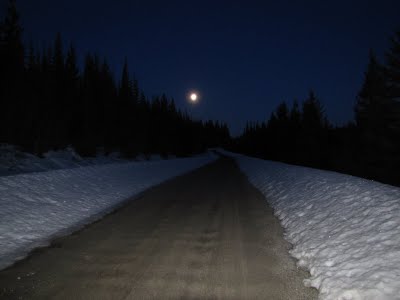
Rabbit Lake moon: 4:10 a.m.
We raced up the Shuttleworth Creek road to the western larch forests, the best spot in the south Okanagan for Barred Owl. A Ruffed Grouse drummed as we stood silently in the cold 3:30 a.m. air, but nothing answered Russell’s hoots. So we drove north along the main forest service road onto the high plateau. Boreal Owls are found in the spruce forests along here, but we weren’t confident of finding any this late in the spring, and came up empty again. The subalpine forests here were still in the grips of full winter, the road reduced to a single lane between high snowbanks and the small lakes frozen solid. We figured the dawn chorus here might be rather quiet, and we were right—American Robins, Hermit Thrushes, Varied Thrushes and a few Ruby-crowned Kinglets sang, but no warblers at all for the first hour. The Spruce Grouse made up for that, though, with a cacophony of clapping and clucking—usually we’re happy to get one or two but we must have heard close to 20!
After a bit of effort we added the subalpine specialties—Boreal Chickadee, Pine Grosbeak, Gray Jay, American Three-toed Woodpecker, Lincoln’s Sparrow. By 5:30 a.m. we were back down in the larches to rack up the woodpecker list, and quickly got Pileated, Black-backed, Hairy, Downy, Northern Flicker, Red-naped Sapsucker and Williamson’s Sapsucker. We hooted again for Barred Owl, but only managed to get a big female Cooper’s Hawk riled up. The big surprise there was a Solitary Sandpiper Russell spotted in a meltwater channel—I guess it was waiting for the higher marshes to thaw.

Pete Davidson at Venner Meadows
At 6:30 a.m. we drove downhill into the ponderosa pine forests, hoping to find Gray Flycatchers and other pine specialties. We did get Western Bluebirds, White-breasted and Pygmy Nuthatches, Calliope Hummingbirds and a few other species, but no flycatchers. That would mean a difficult decision later on. Farther down we saw two large birds in a tree—a Bald Eagle and a Golden Eagle! A Lazuli Bunting sang from the same spot, but the Lewis’s Woodpeckers weren’t on their favourite tree. At the bottom of the hill we added Lark Sparrow and Say’s Phoebe, and suddenly we were back in civilization at Okanagan Falls, where the garden birds were added thick and fast—sparrows, magpies, crows, starlings.
Although we were trying to maximize our species total, we did make some extra effort for western species. We made a detour out of Okanagan Falls to find Northern Pygmy-Owl, but a staked-out pair seemed to have moved on, so we had to content ourselves with other western birds such as Hammond’s Flycatcher, Western Wood-Pewee, Western Tanager and Bullock’s Oriole. Than a U-turn and back to Vaseux Lake to begin our waterbird list in earnest. Redheads, both scaups, Ring-necked Duck, Canvasback, Ruddy Duck, Common Goldeneye and Common Merganser all scoped on the lake. A Veery—my first of the year—called from the birch woods, while White-throated Swifts chattered overhead. We went over to the cliffs and struggled to find a Canyon Wren that had been so obvious the day before but were happy to see a pair of Lewis’s Woodpeckers at last. Species number 117 at 8:00 a.m.—right on track. No Chukars called, though, so we continued south to McIntyre Bluff. Another detour there gave us Steller’s Jay and House Finch at last (phew), but no nutcrackers. Then a pair of Vaux’s Swifts twinkled overhead—another nice western specialty.
At River Road we hoped to get Yellow-breasted Chat, but it appeared the cold spring had kept them farther south. We did hear a Bewick’s Wren, though, a new resident of the Okanagan Valley and now one less species to look for on the coast. Another sigh of relief as a family of Clark’s Nutcrackers called loudly from the pines on the hillside. Realizing we didn’t have MacGillivray’s Warbler yet—usually singing at higher elevations—we decided to check Inkaneep Park, a local migrant hotspot. But the woods there were silent except for a Black-headed Grosbeak and the insistent cu-coooo-cuk of a pair of Eurasian Collared-Doves. Two more western birds on the list! Then we had to decide whether to make the big detour up McKinney Road to get the Gray Flycatchers we missed earlier. Russell insisted we do it—only 18 extra minutes and a great western bird—why were we hesitating? So off we drove up hill, past the big Bank Swallow colony (check!), across the sagebrush flats and up into the ponderosas again. We rolled down the windows at the km-10 cattleguard and chelep!—we were turning around again and off to Osoyoos Lake.
At Road 22 we stopped at a field to listen for a Grasshopper Sparrow heard the day before, but heard nothing but a Wilson’s Warbler from the bushes on the other side of the road (phew! Another missed warbler back on the list). No Peregrine Falcons were soaring over The Throne, either. We worked our way down the Okanagan River channel to a good Yellow-breasted Chat location, but couldn’t hear any of their distinctive whistles. Luckily a Least Flycatcher was calling from the cottonwoods there—a very good bird for this area in mid-May. Back at the fields we scanned for Long-billed Curlews and Bobolinks and Pete quickly found both. Just as we were getting back in the car I heard a distant series of whistles—chat! We left Osoyoos Lake at 10:30 with 145 species in the bag. A little behind schedule and a little behind on the species list, but nothing really to worry about.
We now turned west—the strategy here was to stop as little as possible over the next 400 km to maximize our time on the Pacific coast. As Pete was phoning in an update to Rob Butler, who was blogging about our progress, someone shouted “KINGFISHER!” and there were two shaggy-headed birds on the wire. Sighs of relief all round. A trio of Harlequin Ducks flying up the river were a nice addition as well. We stopped briefly at the Princeton sewage lagoons to pad our teal list, but the only new bird there was a brilliant male Mountain Bluebird. We kept watching the river rocks for American Dippers, but hadn’t seen any by the time we reached Manning Park, so I decided we should check the Similkameen at the Boyd’s Meadow trail. The trail was deep with snow, though, so we let Pete run on while we walked, listening for forest birds. Pete quickly reported that it would be too far to go to the bridge, but we did have a Pacific Wren singing so didn’t leave empty-handed. Sumallo Grove was next—the gate was inexplicably closed so we had to run along the road into the forest of huge cedars and Douglas-firs. Chestnut-backed-Chickadees, Brown Creeper and Red-breasted Sapsucker called as we ran, so we were happy to leave with most of our targets.
Then it was freeway driving into the Fraser Valley. We took the Hunter Creek exit and quickly added Black-throated Gray Warbler, then on to the Fraser Highway for a more leisurely drive through the rural bliss of a sunny spring day in the Lower Mainland. We kept the windows down and were rewarded with the sputtering calls of Bushtits in south Surrey. Our next major stop was the White Rock Pier, where Nathan had scouted some very nice seabirds over the past week. Although it was a Wednesday at 4:30 in the afternoon, the seashore was crowded with sightseers enjoying the sun and the stunning views of snow-capped mountains. We threaded through the crowds as we ran out to the end of the pier with our scopes and tripods, but it was well worth the jog. We added nine new species in quick succession, including a couple of Parasitic Jaegers that Nathan had lined up for us—a hard bird to find on the BC coast in spring. We still needed a few forest birds, though, so we stopped in at Sunnyside Woods and found Pacific-slope Flycatcher and Purple Finch. No Hutton’s Vireo, though.
We were pinning our shorebird hopes on Boundary Bay, and Blackie Spit in particular. And it came through with flying colours—a mixed flock of shorebirds greeted our scopes with Black-bellied Plover, Red Knot, Dunlin, Whimbrel, Sanderling and Western Sandpiper. Elated, we decided to take a detour to Colebrook Road where Nathan had seen some good birds the previous week—Blue-winged Teal, Green-winged Teal, Lesser Yellowlegs all added in quick succession. Suddenly our goal of 200 species was within grasp. We had 179 species and it was only 6:00 p.m.—there were three more hours of light. We scanned the shore of Boundary Bay at the foot of 96th St. and our luck continued: six new species including a Merlin that rocketed by as we returned to the car. A check of a nearby barn netted a Barn Owl. Then it was off to Pete’s territory, the border town of Tsawwassen. He drove us down a residential street near his home, then stopped and said, “Play the Hutton’s song”. Russell teed up his BlackBerry, but nothing answered and after some quizzical looks from the neighbours we decided to give up. Just as we drove off, though, a Hutton’s Vireo began to sing loudly from the hedge. It always pays to keep your windows down!
An overlook high above Georgia Strait produced Pelagic and Double-crested Cormorants, Pacific Loons and a pair of Black Scoters—then, as Pete had predicted, a male Anna’s Hummingbird. It was only 5:20 and we had 193 species—the goal was tantalizingly close. We went as far west as we could go in Tsawwassen, out to the end of the ferry terminal jetty. Black Oystercatcher and Brant were easily visible, and a quick scan of the south breakwater (only metres from the USA border) produced Brandt’s Cormorant and Pigeon Guillemot. Then off through the farm roads to Brunswick Point where Pete had been watching a small lingering flock of Snow Geese—and there they were! A quick stop at Canoe Pass to see one of the local Mute Swans turned into a few anxious minutes, but at last we spotted one of the birds—and with that had beaten Russell’s record of 197 by one species.

Sunset at Iona
We were tempted to drive down the road to Alaksen National Wildlife Refuge to get Barred Owl, but Russell wisely pointed out we could do that after dark, and we had to maximize our daytime effort. So we turned north and drove under the Fraser through the Massey Tunnel, then out to the Vancouver airport and beyond to that Shangri-La of birding, the Iona Island sewage lagoons. The sun was going down in a proverbial ball of fire as I turned my attention to scanning the nest-boxes for Purple Martins. The others searched the marsh for any sign of the Black Tern that had been here for a few days. We struck out on both species, so as dusk fell we went into the sewage pond area. Pete and I flushed a big sparrow from the trail—Golden-crowned—number 199! Then we checked a small flock of Canada Geese and saw the tiny Cackling Goose that had been hanging out with them for the past while—number 200! Elated, we ran over to the river for one last look at the martin boxes—nothing. Russell suggested we take a different route back in case we flushed up some Long-billed Dowitchers, and seconds later his prediction came true. Three dowitchers flew up, giving characteristic “keek!” calls, while another one remained back so we could study it in the lights of the sewage plant.
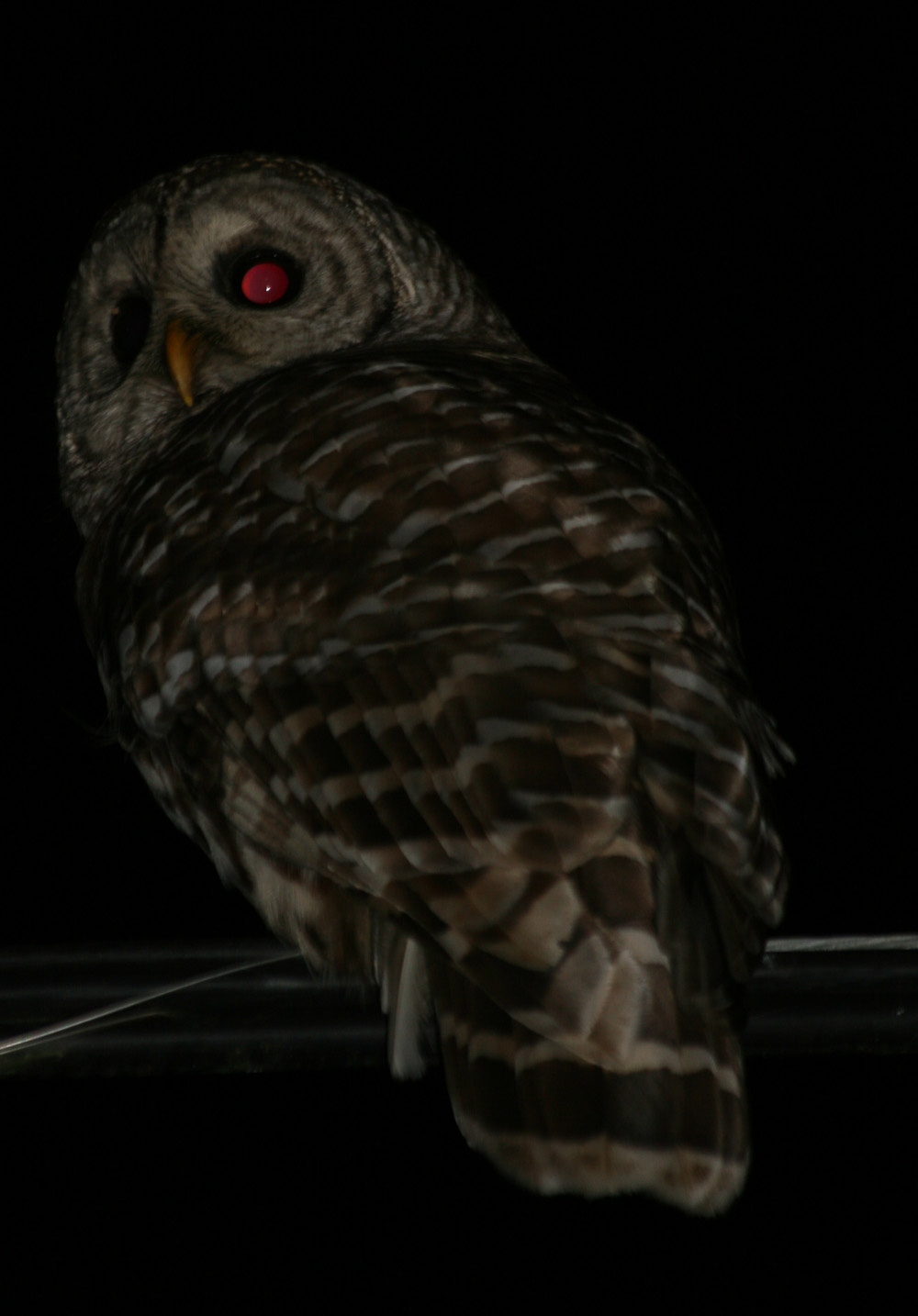
Barred Owl, Alaksen NWA
With the record firmly in hand, we drove back down to Delta and onto Westham Island to look for the Barred Owls that were nesting near the Canadian Wildlife Service offices. As we pulled into the parking lot, the headlights shone on a blob perched on the wire—an adult Barred Owl. From the trees nearby a young owl hissed. It was 10:30 p.m. and we had 202 species—time for bed.
Bicycle Birdathon 2011
The day began badly. I’d set the alarm for 2:30 a.m., hoping to set off on the bikes by 3:00. At 2:15 the phone rang—it was Eva Durance, one of my team members, calling in sick with a cold and fever. As I listened to her apologies, I heard another unwelcome sound—the dull roar of pouring rain. It had been raining when I went to bed, but I had hoped it would have let up by now. I crawled back into bed for a little more rest. Fifteen minutes later, Martin Gebauer, my other team-mate, and I were having breakfast, listening to the rain. At 3:00 I suggested we wait a bit longer, knowing that owling would be pointless in these conditions, but at 3:30 we made the decision to go anyways. We set off on the road to Max Lake, our headlamps illuminating the raindrops.
We climbed up the big hill to the bottom of Husula Highlands and were greeted with our first bird—the song of an American Robin. As we reached Max Lake the rain seemed to be letting up a bit, a Common Poorwill sang loudly from the hillside, and three Soras answered my whistles from the marsh. Maybe the day wouldn’t be a total wash-out. By 4:00 we were up the valley in Flammulated Owl country. The poorwills were singing all over the place and the Townsend’s Solitaires were tuning up, but we couldn’t get an owl to respond to our hoots. We knew they were back—I’d heard one here on my first birdathon three days ago—but I guess the cold, wet conditions weren’t conducive to calling. As the sky brightened slowly, ever so slowly, I managed to call in a Northern Pygmy-Owl and the dawn songbird chorus began in earnest. Spotted Towhees, Dark-eyed Juncos, Black-headed Grosbeaks and Western Tanagers started to sing, one by one.
We cycled back down the rough road and quickly found some good birds. A Veery called from the shrubbery—somewhat unexpected considering the late spring we were experiencing. A few metres down the road a Swainson’s Thrush called, the first I’d heard this year. And just beyond that, a Hermit Thrush! That species should be singing in the subalpine by now, but since the plateaus are still covered in deep snow I imagine it was extending its stay in the valley for a week or two. Back at the marsh, we finally got a Virginia Rail to answer my pathetic imitations, then three flycatchers in a row—Gray, Hammond’s and Dusky. As we cycled back through the rural suburbs of the West Bench we added new species thick and fast, and by the time we got back to the house at 6:00 a.m. we had 60 species in the bag. I mentioned to Martin that last year we had a Great Horned Owl family in the yard, but they hadn’t nested this year so they’d be harder to find. Martin replied, “You know, I dreamt I heard a Great Horned Owl hooting outside the bedroom window last night!” Since he had been sleeping right next to the spruce tree the owls traditionally perched in when calling, I suggested that maybe it hadn’t been a dream after all, but we were reluctant to put the species on the list on the basis of that. Ah well.
We had just got in the house to grab our day supplies when the rain began again in earnest. We had a couple more pieces of toast and some coffee as it poured down, and I began reconsidering my tight schedule for the day. At 6:40 we decided we had to get going, and just then the rain subsided to almost nothing. At this fortunate sign, we headed downhill to the Okanagan River. A Lazuli Bunting flew by on the way down, but the chat wasn’t calling where we had it last year. Martin stopped to take a second look at a medium-sized bird atop a fir that I had written off as a robin, and shouted “Olive-sided Flycatcher!” Another bonus bird—maybe the late spring was going to help us after all, bringing a lot of the high-elevation species down to the valley bottom. A soggy Turkey Vulture moped on a nearby snag and three Great Blue Herons flew out of the new colony near the trail, followed by two Vaux’s Swifts; all nice birds to get. As we reached the Okanagan River channel a male Wood Duck rocketed upstream and a Downy Woodpecker landed in a cottonwood. Things were definitely looking up.
Despite being behind in our schedule, I decided to make the quick trip up to Okanagan Lake, although it had been fairly empty for the past few days. Again we lucked out—a trio of teal, two Blue-wings and a Cinnamon—flew by, and offshore sat a Western Grebe, a Red-necked Grebe and two Common Loons. Doug Cooper, a birder from Vancouver, walked up, asking where the teal had gone. We told him they had disappeared to the east, but, noticing the nice scope he was carrying, offered to look for them. We were carrying a small scope because of weight and scope-safety concerns on the bikes, so this was a real bonus. We couldn’t find the teal, but did get three Bufflehead on the far side of the lake.
At 7:35 we turned south and cycled back down the river channel to Skaha Lake. The Yellow-breasted Chat was finally calling in the Ecommunity Place shrubbery; Martin expressed an interest in actually seeing the bird (he’d never seen one in Canada before), but I convinced him it would be easier (and quicker) to see one at River Road later in the day. At the muddy oxbow by the airport we added Ring-necked Duck, Barrow’s Goldeneye, Gadwall, and our first real rarity of the day—a single Cackling Goose. These small geese are rare at the best of times in the Okanagan, and are usually seen in winter or during the April spring migration.
We got to Skaha Lake at 8:20—only 20 minutes behind schedule. Martin spotted some white objects on the beach and to our delight it turned out to be a flock of four tired American Avocets! Besides being gorgeous birds, avocets are very rarely seen in the south Okanagan. I phoned Laure Neish about the avocets–click here to see her pictures. And the lake itself—usually pretty barren by late May—had a nice array of ducks: Northern Shovelers, Lesser Scaup, Ruddy Ducks and single drake Northern Pintail. The latter species is very hard to find in the south Okanagan in May. Also at the river outlet was a Myrtle Warbler—perhaps a valuable addition if the Yellow-rumped Warbler is officially re-split back into Myrtle and Audubon’s later this year. As we did last year, we weaved through the runners competing in the Peach City Half-Marathon along the east side of the lake. Some of the leaders looked totally spent, and I must admit I wondered whether we’d look like that at the end of the day. When the second-place runner put on a spectacular display of projectile vomiting, though, I swore to ease off on the pace if we got near that state.

Martin Gebauer birding along the east side of Skaha Lake
The trip down the east side was otherwise uneventful, adding Rock Wren, Pygmy Nuthatch, Clark’s Nutcracker, and, just before the south end, a Herring Gull chasing a Bald Eagle. That would be our only gull of the day. All the birds at the north end of the lake had set us back in the schedule, so we had a quick break at the IGA in Okanagan Falls, then kept going south. I saw that the Meadowlark Festival geology tour my wife Margaret was on was still gathered in the Tickleberry’s parking lot, so nipped in there to pick up a pair of dry socks before continuing on to Vaseux Lake. We stopped in at the Vaseux Lake Bird Observatory site where we’d had a Long-eared Owl a few days before. We couldn’t find the owl, but did have one of the highlight experiences of the day. A Virginia Rail was walking through the shrubbery, giving agitated “keek!” calls. Thinking it was interesting to have a rail out of the marsh, I peeked in to get a look, then spied two tiny black fluffball young following it. The parent had found a nice worm for the young, so I backed out and let them finish their breakfast.
At Vaseux Lake I vowed to get back on track with the schedule, so we didn’t cycle up the McIntyre/Irrigation Creek road as we had in the past. Luckily, a Canyon Wren sang loudly near the highway, and we scoped the Lewis’s Woodpeckers on the snag at the base of the cliffs. I figured the chances of seeing a Chukar were minimal, though I’d seen one the day before there, and we kept going down the highway, shaving an hour and a quarter off last year’s pace. We gazed up at McIntyre Bluff for a few minutes, hoping to catch a Peregrine Falcon sailing by, but had to content ourselves with a distant Golden Eagle. We got to Inkaneep Provincial Park by 12:30, but couldn’t find a MacGillivray’s Warbler—I assume those birds just weren’t back yet. Luckily, the local pair of Eurasian Collared-Doves were there.
Then it was over the bridge and up River Road, where the male Black-chinned Hummingbird was waiting atop his bush. A Yellow-breasted Chat sang and Martin spotted it on a bush across the road. Phew! The marshes of Hack’s Pond didn’t have anything new, so we pushed on up Secrest Hill. Literally pushed—I have yet to make it up this wall of a hill without having to walk my bike. I told Martin it would be easier to hear the Lark Sparrows if we were walking, so was happy to hear that spectacular song as we reached the top. As he added the sparrow to the checklist, Martin asked when we were going to get Mountain Bluebird—I told him we’d have to wait until White Lake, as all the bluebirds in these ponderosa pine forests were Westerns. Just then a pair of Mountain Bluebirds flew in and proceeded to feed next to us!
We stopped where the road crosses Park Rill to call for songbirds—we were still missing some easy ones like Cassin’s Vireo. A nice array of birds came into my pygmy-owl imitation: Red-naped Sapsucker, Townsend’s Warbler (another nice high-elevation species!), Western Tanager, and Nashville Warbler, but no vireo. A few hundred metres up the road I whistled again, this time hoping for White-breasted Nuthatch, our big miss in the pine forests. No luck on that front, but a pygmy-owl flew in, followed by a flock of angry robins, crossbills and Cassin’s Finches. Around the corner we eventually did get the Cassin’s Vireo and headed north for White Lake. We reached the Willowbrook junction at 2:45 and I realized we had plenty of time to make a detour out to Green Lake. It would be a totally speculative 13-km round trip, as I hadn’t scouted that route at all lately, but it was good forest all the way, and who knew what would be on the small lakes.
The first lake, Mahoney, immediately came through with three Green-winged Teal, so we were feeling good as we breezed down the hill to Green Lake. At first it looked empty of new birds, with only a few Barrow’s Goldeneyes, Buffleheads and Lesser Scaups, but we pushed on to the north end and were there surprised with a lovely Eared Grebe! We turned around and started back south to Willowbrook, when Martin commented that it would be nice if there were a short-cut to White Lake, which was over the mountains due west of us. I told him there was a track, though it was rather rough and involved a fair bit of climbing. We looked at each other, and decided on the spot to give it a try—at least it might produce a woodpecker or two. As we prepared for the climbing part of the trail by removing our long pants and long sleeves, a White-breasted Nuthatch obligingly flew in to be counted. That was species number 127 for the day, only three away from 130, a very respectable tally for an unassisted bike trip.
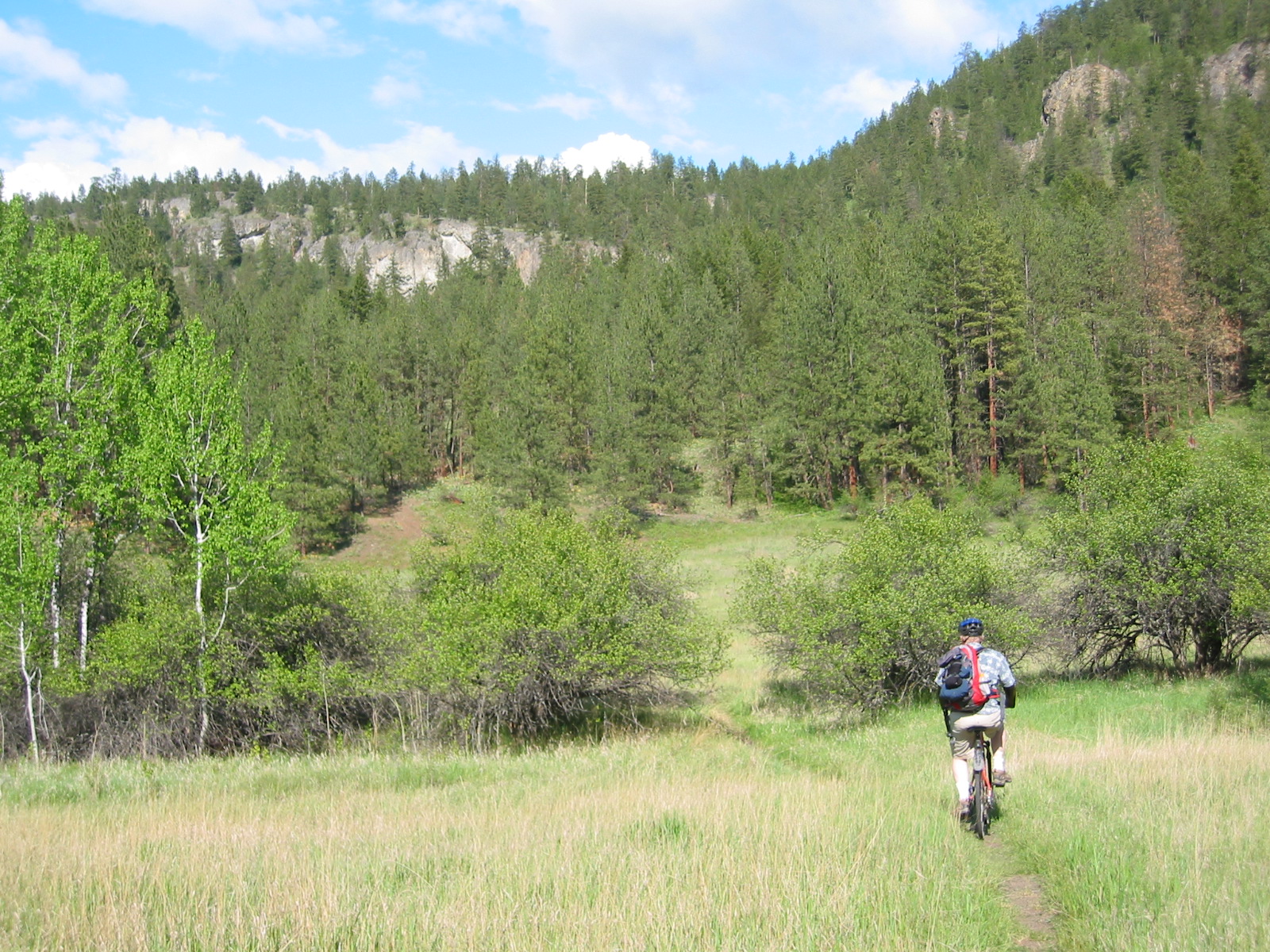
Cycling through The Hole between Mahoney Lake and White Lake
The cycle up the trail through the rugged Kearns Creek valley was spectacular in the late afternoon sun. The rolling hills and meadows, the balsamroot in full glorious bloom turning the grasslands yellow. Up and up we went, then barrelled down through the pines to the willows along the creek and out to the sagebrush of the White Lake basin. No new birds and a lot of new sweat, but in many ways it was the best part of the day. At White Lake the Brewer’s Sparrows were in full song (128!), so we did the loop around the lake and ditched our bikes for a hike through the sage. Maybe we could find a singing Grasshopper Sparrow or kick up a Gray Partridge. We did find a Wilson’s Phalarope working along the lakeshore (129) but nothing else new. Still feeling good, we got back to the bikes and the day started to unravel a bit. Martin’s front tire was flat. He put a new tube in, but found that the valve stem didn’t match his (or my) pump, so could only partially inflate the tire. We gave up plans for a side trip to find the American Kestrels that nest up the Twin Lakes Road and instead limped along to Three Gates Farm, arriving on schedule at 7:00 p.m. There we had a Northern Saw-whet Owl nest lined up (130!) and, just as important, a great hostess in Doreen Olson, who plied us with several glasses of cold water to rehydrate our sweaty bodies.
Just as we were thanking Doreen for the water, it began to pour again outside. This storm had come from nowhere and my thoughts of exploring the lush creekside habitat at Doreen’s, looking for Western Screech-Owl, MacGillivray’s Warbler, and any number of other species missing from our list, went by the board. We waited under cover until 8:00 p.m. then reluctantly said goodbye to Doreen and were off into the rain. Martin turned right at Kaleden to rejoin his family at Ponderosa Point and I continued on to Penticton alone. A car honked as I coasted down the long hill and I looked up to see my car go by with Michael Force waving out the passenger window. That would be my son Russell’s walking team heading home. I cycled back up the river channel as darkness fell, then turned up the KVR trail to the West Bench. As I pushed my bike up the last hill to home at 9:15 p.m., the rain stopped and a Great Horned Owl called—I guess Martin hadn’t been dreaming after all. Number 131 at kilometre 115.
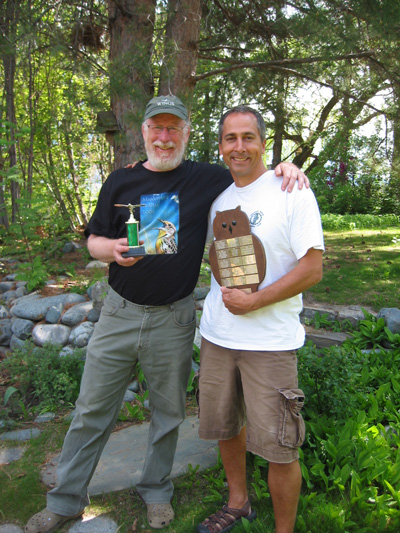
We won the coveted Flammulated Owl award for most species in the Okanagan Big Day Challenge!
——————————————————————————————————————–
Note: I do this Birdathon as a fund-raiser for the Vaseux Lake Bird Observatory. You can make a pledge if you like by going to my Baillie Birdathon webpage and clicking on Sponsor Me. Thanks!
 Dick Cannings: Birds and Books